
Talk
and its currency in jiujitsu

I remember speaking with a co-worker (let’s call him James) back in 2009 about who would win a tennis match between Pete Sampras and Rafael Nadal, two of the absolute tennis greats that ever graced the sport. They would not meet in their peaks. Sampras retired in 2002 when Nadal was just 15. But the comparison was inevitable.
James had very strong opinions why Nadal would win. Lecturing me on the power of Nadal’s forehand against Pete’s, and so on. He seemed to have all the answers so I asked him if he played any tennis. He said his mother made him stop when he was young. He said gripping the tennis racket messed his fingers, and interfered with his piano lessons.
In contrast, I used to play a lot of tennis. I would spend entire summers in tennis courts. I would play even on rainy days until the pavement became slippery. I would injure my back, elbow, and knees because of tennis, grounding me for days. But I would go right back to the court when I got better. I devoured every magazine on tennis that I could get my hands on. On the night when my mother bought me Agassi’s tennis shoes (the Nike Air Tech Challenge III), I slept with them on. Everything was about tennis until my early 30s when my knees could no longer handle the way I wanted to play.
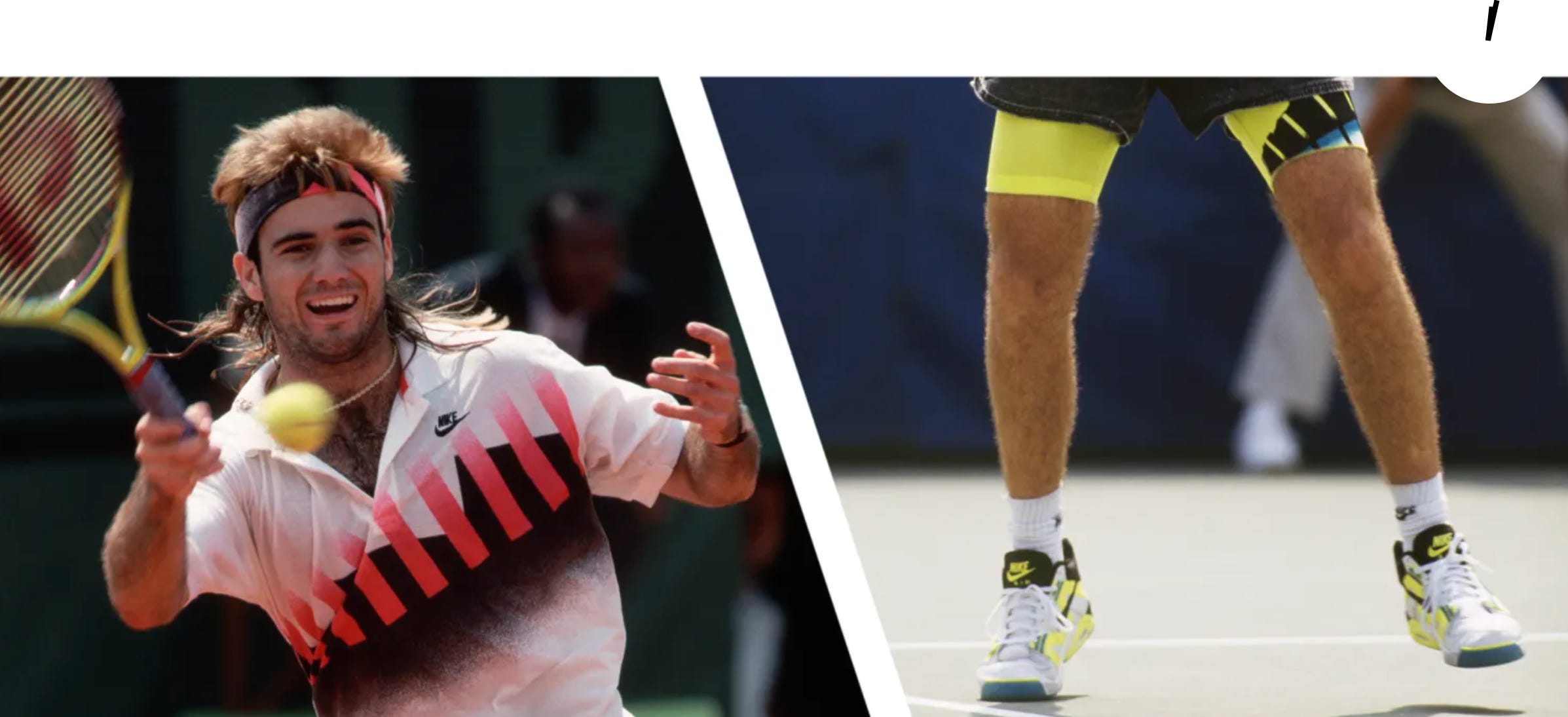
Andre Agassi and his Nike Air Tech Challenge III.
So you can imagine that James’ mommy-made-me-stop reasoning sounded absolutely absurd to me. And everything he said before that was gobbledygook.1 If he didn’t play tennis, he CANNOT credibly say that one player would be better than another. So I walked away from that conversation. I did not want to listen to someone about playing tennis, who was afraid that holding a tennis racket would mess up his fingers. At any rate, there can be no argument that Pete would beat Rafa at his peak.
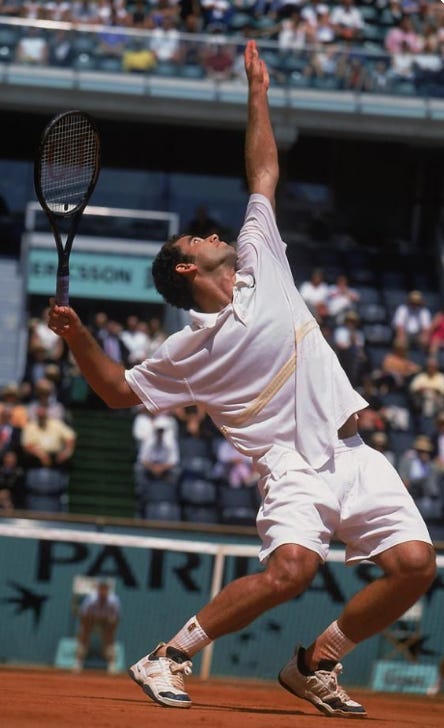
Pete Sampras was one of the greatest, if not the greatest, who ever played. He would trounce Rafa in his peak. CTTO.
To be sure, there is a time to talk. One would be a fool to fail to recognize the immense value in words. As Mary Shelley wrote, “words have more power than any one can guess; it is by words that the world’s great fight, now in these civilized times, is carried on.” Words can rouse and inspire, as in Churchill’s timeless exhortation given in the early days of WWII in Harrow School, to “never give in, never give in, never, never, never, never.” Words can also hurt, and lead to destruction. For example, were it not for Sinon’s compelling story, the Trojans would not have brought the large wooden horse into their city.
But words must always co-exist with action; talking with doing. Like two race cars on the grand prix. While they try to outpace each other, they are both essential to complete the picture.
This week with the team is one of the most challenging. The second-to-the-last week before competition usually is. This is the time when a competitor grapples more and most, not only with training partners, but also with injuries, weight-cut, self-doubt, and other mental issues. If you get past the second-to-the-last week you’re more or less set for the challenges of the competition. If you are not ready by this time, 4 out of 5 times you will not be ready for the competition.
The second-to-the-last week is also very important for me as a coach. I try not to teach new techniques by this time and instead focus on my students’ movements and fight awareness. The time for talking and lecturing has passed. No more talking at this time, at least not as much. At this time, competitors must do more, and make do, with what they have. Talk, at this point, holds no currency. Like Mickey Mouse money, talk is now cheap.
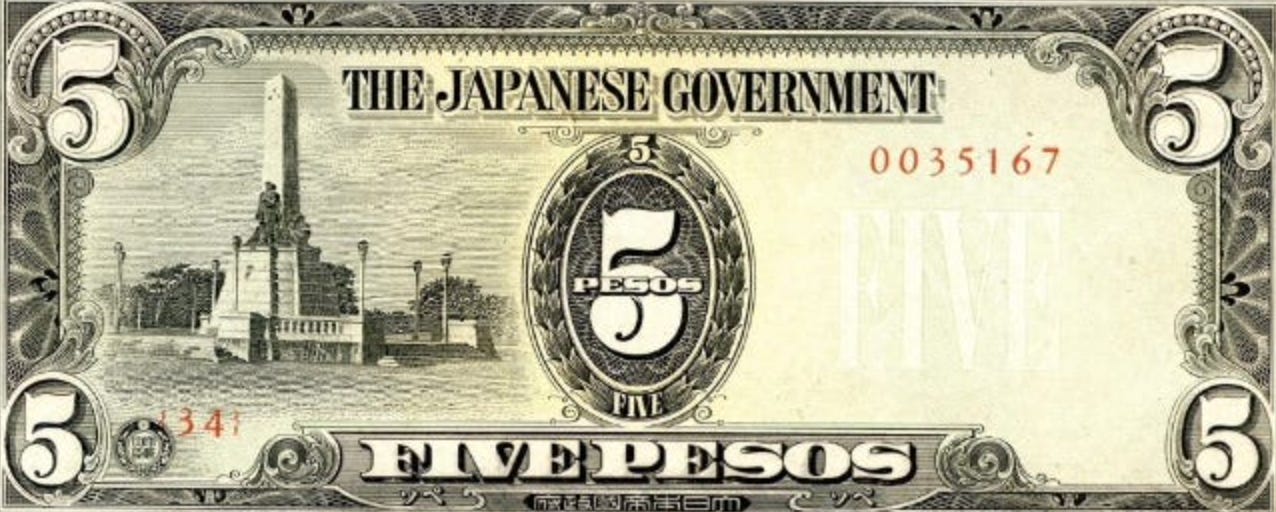
Nearing the end of WWII, Japanese issued currency in occupied Philippines became valueless, earning them the nickname “Mickey Mouse money”.
This is the world of jiujitsu — in equal parts talking and practicing. One after the other, in cadence, and in balance. Quite apart from most martial arts disciplines today, what we practice in the gym is very close to what we can do in many self-defense situations. A jiujitsu practitioner — whether a competitor or a hobbyist — can walk the talk.
No self-respecting practitioner will start talking like James without having spent time on the mats. The mats will expose all the gobbledygook if not paired with action.
As we all know, the mats don’t lie.
Gobbledygook is unintelligible nonsense, often a bunch of big words that you can't comprehend. From: https://vocabulary.com/dictionary/gobbledygook#:~:text=Gobbledygook%20is%20unintelligible%20nonsense%2C%20often,listening%20to%20or%20reading%20it.